

Hoosier-tucky

home
August 1, 2017 – We are officially Indiana residents.

Growing up in Louisville, we always made fun of Indiana. The topography (or lack thereof), the corn, and the sports teams. Well, my family and I have been Indiana residents ourselves for a year now, and it didn’t take me nearly as much time to learn they’ve been making fun of Kentucky for just as long.

There’s a common suffix Hoosiers use to describe something that is unsophisticated, bucolic, or red neck. Just tack on “tucky” at the end of the word, and there you have it. All good corn eaters know what you mean. The rural town next to us is Bargersville, but an outsider might believe the actual name is Bargertucky. And don’t be fooled by Morgantucky. The community 10 miles southwest of Franklin is really called Morgantown.

How did we get here in the land of the pork tenderloin?
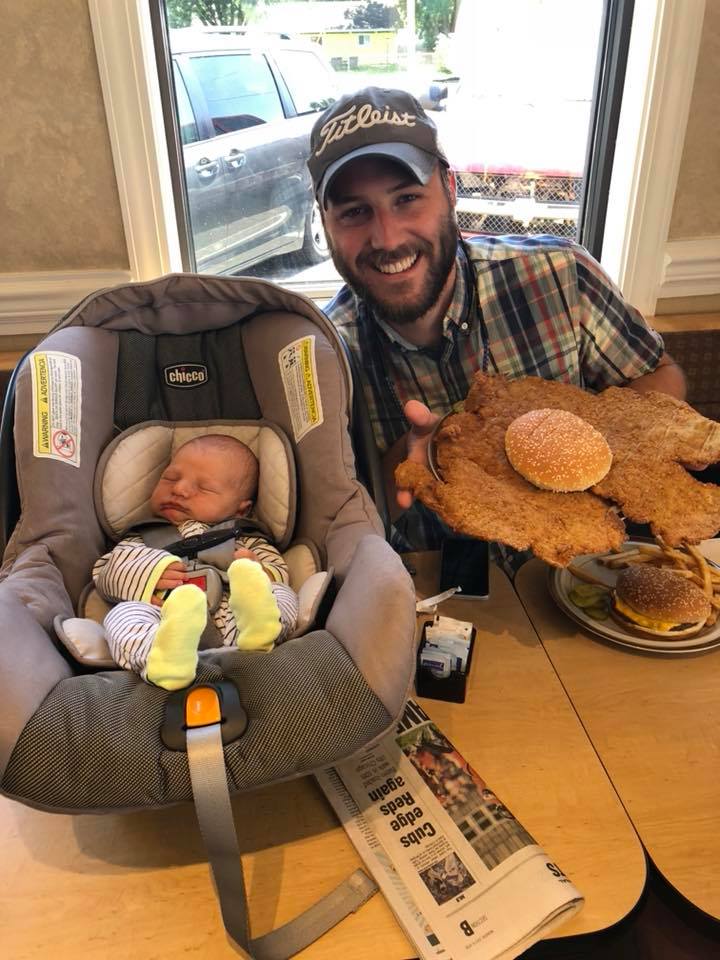
tenderloin
Edinburgh Diner serves a pork tenderloin bigger than a human.

It’s an improbable story none of us saw coming.

In 2016, Amanda finished her masters degree at Xavier University and passed her boards. She was now certified to be a nurse practitioner, and we were new parents of our baby girl, Reed.

The job hunt commenced right away. Between the two of us, we’d been living in Cincinnati for a combined 10 years, and we were more than happy in the Queen City, so Amanda began searching for opportunities there. We’d always heard the market for NPs was oversaturated in Cincy, and after several months of applying, that truth was becoming more and more apparent.

The writing was on the wall – we were going to have to broaden the search.

That did the trick. Within days of opening up the job hunt to a national scale, Amanda landed a half a dozen interviews. She had opportunities lined up all over the place, and we knew moving was inevitable.

We were both okay with relocation, but it would come at a cost, as it almost always does. I was a full time organizational psychologist working in the training department of a large local real estate company. It was a great job with outstanding people, and I grew tremendously as a professional there.

However, even with a significant promotion in the works, my earning potential wasn’t comparable to Amanda’s as a NP. We made the decision as a family that this would be the season we would focus on her career. It was a no-brainer at the time.

In addition to my full time job, I was a minister at Echo Church, a small urban congregation in the neighborhood of Walnut Hills. As I was working on my masters in divinity degree at Cincinnati Christian University, I connected with Steve Carr, the founding elder of Echo. Steve and the members at Echo gave me something I will never forget – an opportunity to jump into the ministry field, something that is near impossible to do for an Ohio transplant who was raised Catholic. I will forever be indebted to Echo for the experience my family and I had there.

Leaving Cincinnati meant leaving Echo, the people we loved, the people who gave us a chance. That was the most difficult part about this transition. But we knew we had to go.

A week after Amanda started applying outside Cincinnati, she accepted an offer for a NP job in Burlington, North Carolina. Burlington is a nice town nestled in the Piedmont region, 30 minutes from Durham and even closer to Greensboro. We had a couple family members there. It was a little further south but still within 8 hours of Louisville. This was going to be a perfect fit!

We called our parents and told some close friends – the Wheatleys were moving to North Carolina.

Or at least, that was what we believed for the next 24 hours.

When Amanda had a follow up phone call with the hiring manager the next day, she learned some more information about the job’s duration and schedule, some information that made the move a little less exciting. They wanted her to be a temporary floating NP working five days a week with no home clinic – a tough gig for a brand new mom in a new city. We still have no idea how these details weren’t communicated from the start, but now we had a big decision on our hands.

That same week, Amanda heard back from another job she applied for – this one was labeled “Indianapolis”. She was offered a NP position at a clinic outside Indy, a place within 2 hours of Cincinnati and Louisville. After some prayer and conversation, Amanda let the Burlington folks know the new details were a deal breaker for us, and we’d instead be moving to… Indiana.

The hiring manager gave Amanda a choice – Greenwood or Franklin. We knew nothing about either town. So we googled and realized that Greenwood was a little closer to downtown. When Amanda called back the next day to accept the NP job in Greenwood, the hiring manager said, “I’m sorry – the other person we hired beat you to it. You’ll be working at the Franklin clinic.

Sounds good. See you there.

The day after we found out we were moving, I called Steve to tell him we were leaving Cincinnati, and I’d have to resign at Echo. To this day, that was the most gut wrenching phone call I have ever made.

When I shared our news, Steve graciously said, “We’re sorry to see you go, but we’re so happy for your family. You served our church well. We are better off because of the Wheatleys’ time at Echo.”

And in the next breath, Steve asked, “So where are you all moving?

I responded, “It’s a little town outside Indianapolis. You probably won’t know it.

Steve said, “Which town is it?

Franklin, Indiana,” I said.

You’ve got to be kidding me,” Steve said, stunned. “My brother-in-law and sister have a church in Franklin. He called me last week to see if I knew any ministers looking for an opportunity.

Do you see what happened here?

I called Steve to resign and reluctantly move to a town I’d never heard of in Indiana. I had zero job leads. I was mentally prepared to do the stay-at-home-dad thing while I showered Indianapolis with resumes. My future was a massive question mark.

And in the same phone call, mere seconds after resigning, Steve not only knew our new little town – he knew what my next job would (probably) be.

That brother-in-law was Josh Cadwell, and that church was Victory Christian Church. My start date ended up being before Amanda’s start date. Our workplaces are less than two miles apart. Most people still think we moved to Franklin for me!

If you call all that coincidence, you’re either trying too hard or you haven’t been to Franklin. A flat, corn eating, bad-sports-teams-loving town in the state I grew up making fun of.

A town that I now proudly call home.
Mere Christia…Insanity

In the summer of 2015, I was taking a week-long seminary class in Cincinnati, the city my wife and I lived in at the time. In that class, I sat next to some people from Indian Creek Christian Church (located in Indianapolis) who were in Cincy just for the week. They were really nice people. Seth Bryant was one of them. The class ended, and we exchanged contact info.
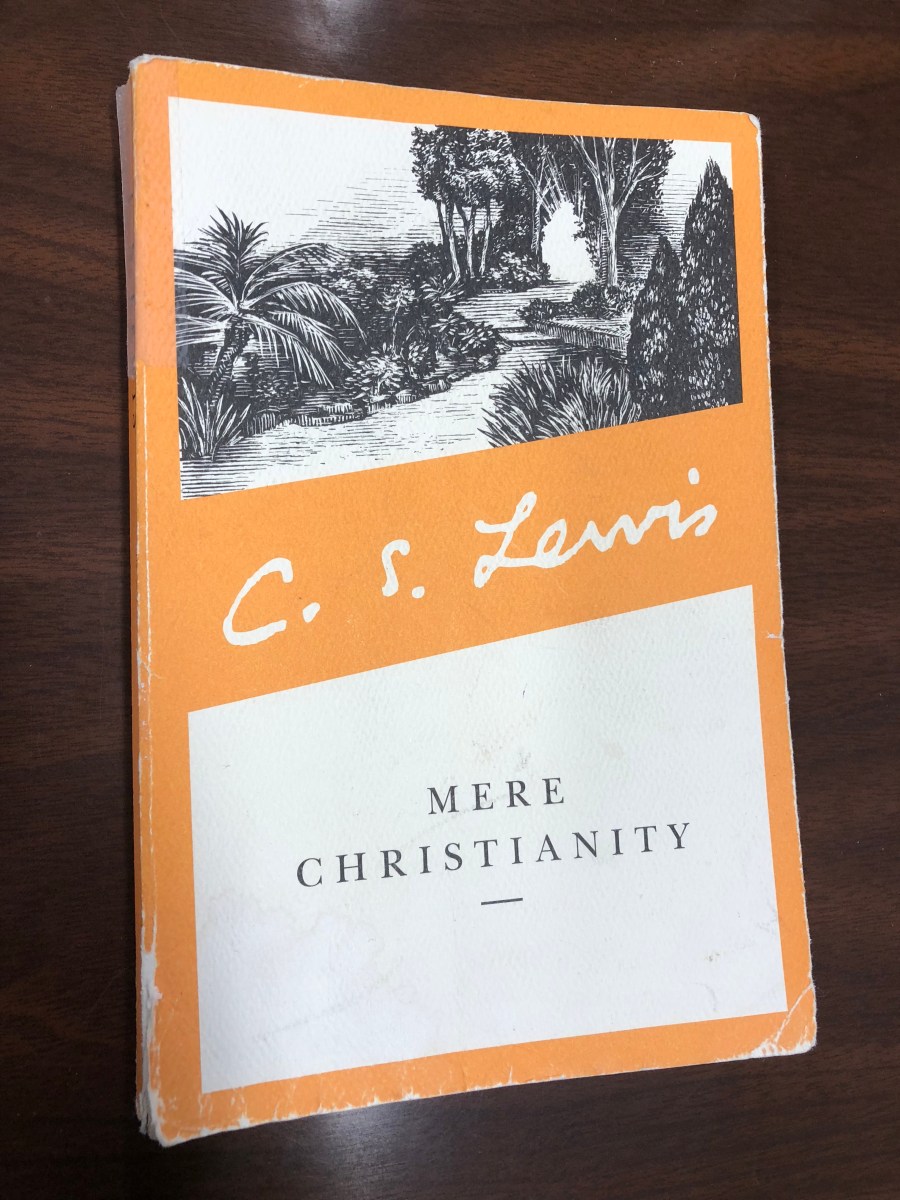
When my family and I moved to the Indy area and got settled here last Fall, I remembered Seth and checked social media to see what he was up to. Seth had posted on the facebooks that he and his family were leaving Indy and moving to Roanoke, Virginia to lead a church there. Bummer.

I’ve been to Roanoke before. It’s a charming little town in the mountains. My buddy, Ryan, grew up there and moved back after we graduated from Kentucky. He and I had remained really close since graduation despite the distance.

2016 was a really tough year for Ryan. I won’t share too many details, but one of about six terrible things that happened to him (none of which he could control) was a house fire where he lost everything, including his dog, Remington. Any one of these things he endured last year would be enough to make a person want to give up, but Ryan hung in there. Dude is both physically and mentally strong, but every man has his breaking point.

So through all that, Scott (our mutual friend and fraternity brother), myself, and a couple other people have been praying for Ryan. That God would move in his life in a way that was unmistakable. That in the midst of that storm, he’d find Jesus. Maybe they believed it would happen. I just didn’t see a way, but I prayed anyway.

Someone Ryan knows through work gave him a copy of Mere Christianity by CS Lewis. I remember when he brought it up in our group chat, “Has anyone read Mere Christianity?” Ryan asked.

I laughed. Apart from the Bible, no book had ever had an impact on me like Mere Christianity did. I knew every inch of that book. For goodness sake, we named our first born son after the author (for real, though)! I sent Ryan this photo of my beat up old copy of it, which I’ve pored over many times and loaned to other people.

C9XAKiPDRgeaDMnsiFw

“This could be the start of something,” I thought.

Back to Seth.

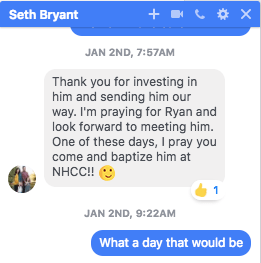
So I contacted Seth on the second day of the year and said something like, “Hey man. This is David. Remember me from that week-long seminary class? I saw that y’all just moved to Roanoke. Congrats on the new job! Hey, I’ve got a buddy in Roanoke. His name is Ryan, Not sure where he stands on the whole Jesus thing. He’s had a year from hell, but a few of us have been praying for him. If I can somehow get Ryan to come by your church (NHCC), will you say hello?

Here’s what Seth said.

Seth fb message

So I told Ryan about “my buddy from Seminary’s” church, and he went one Sunday in January. Seth and Ryan met after the service, and Ryan came back again. And then again. And again.

Dude was on fire. Listening to sermons, reading the New Testament, asking questions about it all. “Was this really happening?” I thought. “You’ve got to be kidding me, God.

Last week, I got a text from Ryan. He told me he had made the decision to be baptized.

This morning, Scott and I got up at 5am and drove 6 hours to be there for it, surprising Ryan.

I don’t personally know anyone who had a cumulatively more difficult 2016 than Ryan did. I also don’t know anyone or anything who could turn all of that suffering into something good and purposeful. No one other than God.

I know two people in the entire Commonwealth of Virginia. Today one of them baptized the other.

I don’t know what kind of storm you’re going through right now, but my advice to you is simple – Don’t ever, ever count God out. Ever.

“Look for Christ, and you will find Him, and with Him everything else thrown in.”

-CS Lewis, Mere Christianity

“How could a good and loving God allow evil to exist?”

This week will mark the 15th anniversary of 9/11. A day that was so horrible we don’t even say the year when we talk about it. We don’t need to. For those around my age and older, the memories are vivid. Clouds of smoke pouring out of the buildings, hoards of people sprinting down the streets covered in debris, and the image of the second plane barreling toward the tower, the third at the Pentagon, and the fourth in Shanksville.

As a seventh grader, I could tell it was bad. My teachers were crying. My wife, then a sixth grader in a Connecticut suburb of New York City, had a different experience. Parents who could escape the madness rushed to pick up their kids from school. Everything shut down. Some of her classmates lost their moms, dads, aunts, and uncles that day. Grief counselors came in, and for a long time, their community wasn’t the same.

Fifteen years later, and the world still seems like a pretty dark place. There’s war, famine, disease, slavery, torture, natural disaster, and violence. No one escapes suffering. Some people just seem to have it worse than others. But everyone knows it’s there.

How, then, does God – all powerful, all loving, good God – allow this stuff to happen? This is a question folks have been wrestling for such a long time that it has its own name. Philosophers and theologians call it theodicy. There are volumes of literature on this single question that stretch back centuries. But this is a blog, and you should probably be doing that thing you need to get done, so I can only hit on the tiniest fraction of what is an age old conversation.

You can go lots of places with this topic, but there’s only one place you can start – with a question: “What do you mean by evil?” No, this isn’t some kind of smart-ass rhetorical trick. I mean the question exactly how it sounds. What does evil mean to you? It turns out everyone I’ve ever asked answers the same way. In 2016, we can all agree on something – evil sucks. It’s immoral, wicked, and just plain wrong. It’s tragic. It hurts. It makes us swell with anger. It makes us break down and cry.

But we can’t leave it there. Evil, alone, doesn’t make sense. The only way we can know what is immoral and wicked and wrong is if we’ve perceived what is moral and virtuous and right.

As CS Lewis says:

“A man does not call a line crooked unless he has some idea of a straight line.”

If we’re sure that this world is cruel and unjust, we are assuming the reality of some standard by which we make this assessment. Whether we’re pointing out the suffering in 9/11 or in a malignant tumor, we’re essentially saying, “This isn’t how it is supposed to be.” Good is the standard. Evil is the deviation.

So where does good come from? In a naturalistic worldview with no God, this is a difficult question. For the benefit of the human species? No, there are too many problems with that view. First, selfishness is often more beneficial for survival than good. And this kind of “goodness” isn’t the kind we believe in anyway. When a famous athlete grants a Make-A-Wish for a dying child, it’s not “good” because it prolongs the human species. It’s good because each living individual is born with intrinsic worth and dignity.

Secondly, if “good” were defined as that which benefited the survival of the species, we should ask – “To what end?” In the naturalistic worldview with no God, the whole universe is the result of a random explosion of mass with no purpose, destined for a grand implosion into eternal nothingness. If that is what you believe about life, what good does “good” really do? It’s like washing dishes on the Titanic.

Fortunately, good is much deeper than that. Good transcends the bounds of this life. Evil is deeper than that too, but according to the Christian worldview, this life can be where evil ends forever.

And why the focus on evil? There’s another question we should be asking. It’s the reverse of the original question. It’s this: How could the world be so good without a good and loving God? No matter what you believe in, you feel something special when you see one of those soldier-reuniting-with-family montages. Ever climbed a mountain? It’s hard to forget the magical sensation while gazing down at the scene below. What about the feeling you get when you hold a newborn? When you wake up on Christmas morning? When you serve someone who cannot help himself? This is goodness, and it’s everywhere, all around us. Where does it come from, and why are we wired to gravitate towards it? This is a question everyone has to answer, regardless of what you believe in.

I agree with you – it’s not supposed to be this way. The world shouldn’t be full of hatred and violence and suffering. But those things happen because God gave us free will. Stay with me here! Every day you can make choices because you’re a free agent. If you want to go to work, you can. If you want to stay home and play Madden17, you can. You can choose to buy your friend a hot coffee or pour hot coffee on her face. God won’t intervene. We have the license to make choices every second of our lives because we are free will persons, not robots.

With the ability to choose, we allow the best possible good as well as the worst possible bad. That’s just the way it is. It’s a necessary feature of free will. But why couldn’t God just allow ALMOST all of our choices and prevent us from making the evil ones? Well, that would be a violation of free will.

Theologian Greg Boyd puts it this way:

“If I gave Denay (his daughter) five dollars, can I completely control the way she spends it? If I stepped in every time she was going to spend this money unwisely according to my judgment, is it really her money at all? Did I really give her anything? If the only things she can buy with her money are the things which I decide are worthwhile, is it really her money at all? Is it not rather still my money which I am indirectly spending through her?”

See, if God gives us freedom, it must be, at least to a significant degree, irrevocable. He’s got to have a “hands off” attitude about it, giving people the chance to choose freely to do amazing good, horrible evil, or anything in between. This evil we experience in life is a necessary possibility of choice. If that possibility wasn’t there, we wouldn’t have free will, and we wouldn’t have good.

This is meant to be an intellectual conversation about an emotional topic. and that’s not really fair. Reasoning can only bring so much comfort to a mother who lost a child or a refuge forced out of his home. I believe the Christian worldview makes far and away more sense that any other explanation for evil, but I also believe it offers the most hope.

The truth is we are not alone in our suffering. It’s all over the Bible. Even the closest people to Jesus suffered tremendously. Evil knocked them down as they were imprisoned, ridiculed, beaten, and tortured. Many of them died at the hands of evil. And then for two thousand more years, Christians suffered. Still some are being oppressed and killed for their beliefs today. If someone told you aligning with Jesus would prevent suffering, he didn’t read the Bible.

Moreover, the Scriptures attest to the suffering of another man, a man who would suffer tremendously on our behalf. At the very core of Christianity is a suffering God-man, Jesus. What could be more offensive, more obscene than the all powerful, all loving God submitting Himself into the hands of men He knew would brutally murder Him? Betrayed by friends, mocked by scoffers, hated by the religious elite, tortured and crucified by captors – Jesus endured pain and humiliation that most of us will never fathom. Then He was separated from the Father, enduring the ultimate penalty we deserve, so we would have the opportunity, or the choice, to love Him back. But again, that is a choice, the most important choice we will ever have in our lives.

Romans 8 shows Paul’s words to a church that would be severely persecuted:

“I consider that our present sufferings are not worth comparing with the glory that will be revealed in us… For I am convinced that neither death nor life, neither angels nor demons, neither the present nor the future, nor any powers, neither height nor depth, nor anything else in all creation will be able to separate us from the love of God that is in Christ Jesus our Lord” (18,38-39).

God gave us free will. Free will allows for both indescribable, unfathomable, fall-to-your-knees-in-awe good and horrifically devastating, tragic rip-your-hair-out evil. Sometimes evil chooses us. But when we choose Jesus, evil receives a death notice. And until that day, our hope rests in the good, good God who loves us.

“I don’t believe in God because science.”

There’s a widespread notion that says theology and science don’t mix. Either God or science. If you believe in science, you can’t believe in some supernatural deity. When you think about it, the idea of God is just not… scientific.

I agree. Well, with that last statement anyway. The existence of a higher power is indeed not scientific. Science is the study of the natural world. By definition, science finds its bounds to be within nature. If God is supernatural, meaning “outside nature”, we shouldn’t expect to be able to place Him under a microscope. After all, science is a set of intellectual disciplines. God is not.

But the dichotomy of science and theology is false on many more levels.

In order to see where science actually stands on the subject, it’s probably best to start with the world’s greatest scientists. Since men and women began studying the natural world, the vast majority of them have ascribed their subject matter to a Creator that stands outside of it.

CS Lewis said, “Men became scientific because they expected law in nature. And they expected law in nature because they believed in a law giver.”

Here is a tiny fraction of scientists you may have heard of, whom are also theists:

  • Francis Bacon – creator of the scientific method
  • Galileo – astronomer, physicist, engineer, mathematician
  • Sir Isaac Newton – discovered gravity and laws of motion
  • Johannes Kepler – astronomer of the Scientific Revolution
  • Gregor Mendel – discovered the basic principles of heredity
  • Lord Kelvin – inventor of the Kelvin scale of temperature
  • George Washington Carver – scientist, botanist, inventor
  • Louis Pasteur – chemist and microbiologist who invented pasteurization
  • Francis Collins – leading scientist of Human Genome Project, Director of NIH
  • Joan Roughgarden – evolutionary biologist, professor at Stanford
  • Robert J. Asher – palaeontoligist, Fellow at American Museum of Natural History
  • Gerhard Ertl – Nobel Prize winning chemist
  • John Lennox – Oxford professor of Mathematics, philosopher of science

This list, alone, should tell us that science cannot be diametrically opposed to faith. And there are countless more theists in science than this minuscule collection. The thing to realize is that faith was never a hindrance to science; it was a motivator for its inception, and still today, faith inspires some of the most brilliant minds toward discovery.

Second, science and theology ask different questions. Science answers the question “how.” Plants can grow because they have something called chlorophyll that captures the sun’s energy and uses it to make sugar out of carbon dioxide and water.

Science also answers the question “why”, but only on a level of functionality. The ocean tide rises and falls because of a gravitational attraction to the moon.

Theology, however, answers a different “why”, a teleological “why”. God created people so they might reflect His glory and choose to partake in His eternal love. These “why” questions stand outside the reach of science. Studying particles or manipulating variables will never answer the deeper questions of “why”.

Another grave misconception fueling this false dichotomy is the idea that science is the only way to truth. Let’s look at that statement for a second: “Science is the only way to truth.” …Really? Because that statement, in itself, is a truth claim. And it’s not scientific! Do you see the problem here? A massive logical contradiction. Beware of people who make an assessment and then excuse themselves from it.

What about ethical truths? Consider this: A man walks into your workplace today and opens fire on anyone who walks by, killing dozens of innocent people. That sounds horrific, right? That man ought to be punished severely, right? Well, what does science have to say about the oughts of the world? Nothing. Yet, any sane adult with the most basic cognitive functioning will tell you the assailant was wrong. He acted immorally, to say the least. This is called objective morality, and it cannot be explained by science. What, then (or who), gives us this moral law?

Still, there is an erroneous assumption that things can either be explained by God or by science. For example, the sky is blue either because molecules in the air scatter blue light from the sun more than red light OR because God made it that way. My question is why would these be mutually exclusive? Likewise, does the automobile work because of an internal combustion engine or because Henry Ford made them that way? You see, to create an either/or situation between mechanism and mechanic is purely nonsensical.

As the great Oxford mathematician John Lennox puts it:

“I am fascinated that people could go to the beach, see the letters of their name written in the sand, and immediately postulate an intelligence behind it. And yet, people can look at the 3.5 billion letters of the human genome all in the right order, the whole thing acting like an impossible computer program, and come to the conclusion that it is only chance and necessity.”

The more we understand art, the more we can understand the genius of Rembrandt. The more we understand musical composition, the more we can understand the brilliance of Mozart. The more we understand the unmatched complexity of nature, the more we know about God. “The heavens declare His handiwork” (Psalm 19:1).

Science is a fascinating set of laws. The breakthroughs and discoveries rooted in scientific investigation are innumerable. I, personally, am so amazed by science that I chose to make it my life’s work, specifically the study of human behavior in the workplace. But what’s even more amazing than this incredible set of laws is the Law Giver, Himself. Laws can do much to describe things, but a law has never created nor caused anything.

“For since the creation of the world God’s invisible qualities – His eternal power and divine nature – have been clearly seen, being understood from what has been made, so that people are without excuse” (Romans 1:20).

So to claim that something (the natural world and all of its tenants) came from nothing… Well, I’ve never heard anything less scientific.